

EQUITA-Bocconi 2026 Event: "Italian household savings and access to capital markets"
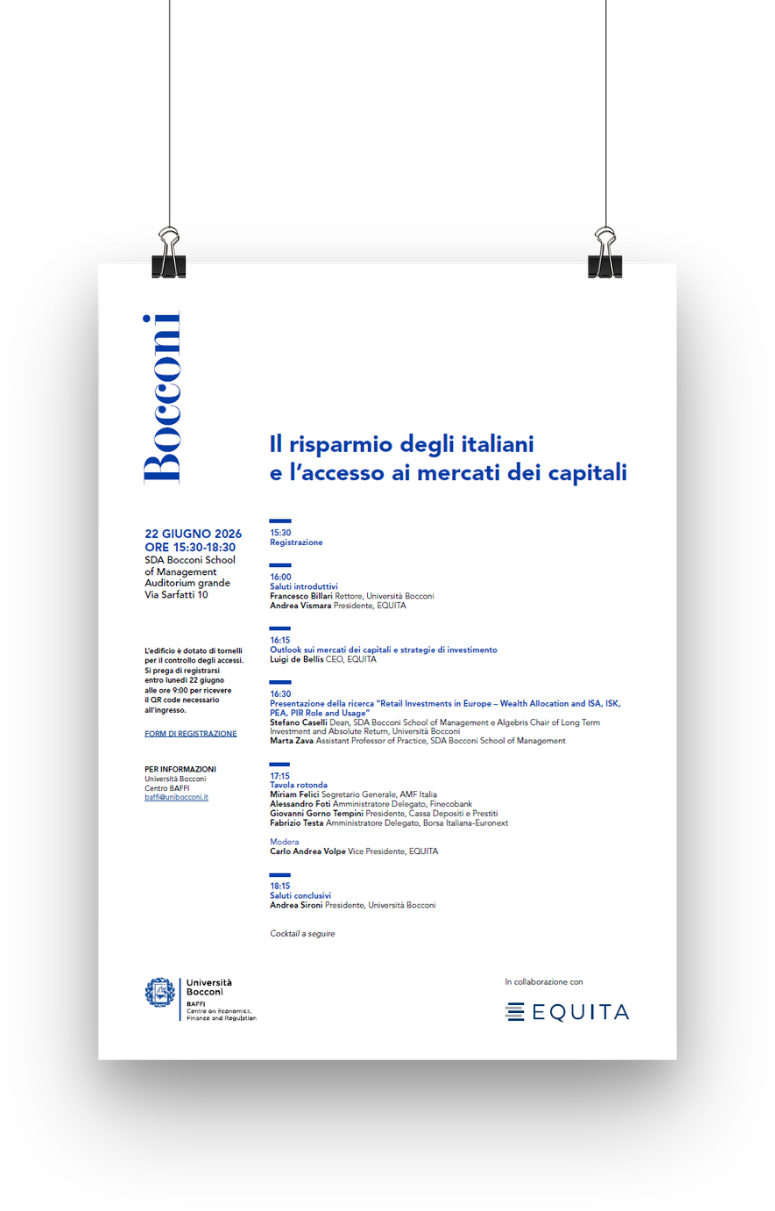
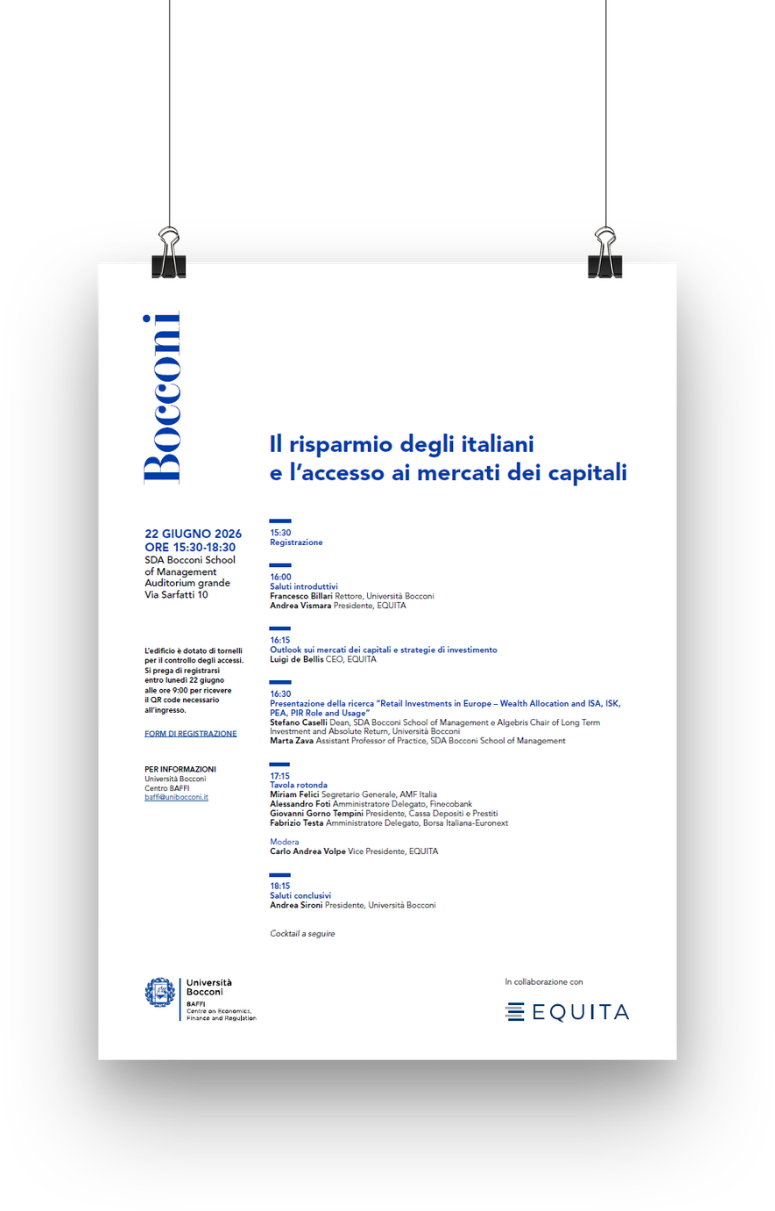
Bocconi University and EQUITA present the BAFFI Centre research “Retail Investments in Europe – Wealth Allocation and ISA, ISK, PEA, PIR Role and Usage”. How can Italian savings be channelled into capital markets and become a driver for the real economy and innovation?
Milan, June 22nd, 2026 – Europe is currently working to set up the Savings and Investments Union (SIA) and new financial instruments aimed at bringing retail savers closer to capital markets. The aim is to drive private savings towards productive investments and the real economy.
The thirteenth edition of the conference, promoted by EQUITA and Bocconi University as part of their long-standing partnership to foster the development of capital markets, today hosted the presentation of the research “Retail Investments in Europe – Wealth Allocation and ISA, ISK, PEA, PIR Role and Usage” edited by the BAFFI Centre.
The paper – presented by Stefano Caselli and Marta Zava during the event – analyses the composition of household wealth and portfolio allocation in UK, Sweden, France and Italy over the period 1988-2024, with a specific focus on the role of tax-advantaged retail investment instruments: ISA, ISK, PEA and PIR.
The research shows that European retail investors benefit from significant private wealth, yet a disproportionate share of it is invested in cash deposits, real estate and insurance-based products, rather than to productive financial assets and higher-return investments. This allocation contributes to increase the persistent “equity gap”, which constrains both long-term household wealth accumulation and the ability of capital markets to support companies, innovation and economic growth.
This issue is particularly relevant in Italy, where household wealth remains high, but allocation continues to show strong preference for liquid, low-yielding and low-risk assets, government bonds and real estate. Although recent years have seen a gradual rebalancing towards financial assets, investments in equity remain limited and retail savings still struggle to translate into patient capital for companies.
The study compares four tax-advantaged retail investment instruments. The UK’s ISA, introduced in 1999, is the most mature and comprehensive financial instrument, with £726 billion in assets and complete tax exemption on both income and capital gains. Sweden’s ISK, introduced in 2012, represents a benchmark in Europe for simplicity, administrative efficiency and retail investment democratization: it replaces capital gains and dividend taxation with a flat annual levy on the value of the account, thereby removing the need for transaction-level reporting and reducing lock-in effects. France’s PEA, introduced in 1992, is an equity-focused investment account designed to promote investment in European equities, with tax benefits subject to a minimum five-year holding period. Italy’s PIR, introduced in 2017, were instead designed with a more explicit industrial policy objective: to channel household savings towards the real economy and, in particular, towards SMEs and domestic companies.
According to the research, tax incentives are key for the success of retail investment accounts, but these are not sufficient: simplicity, flexibility, absence of excessive constraints, regulatory stability, straightforward tax treatment and lower administrative burdens are at least as important as the tax benefit. Instruments with no holding-period requirements, broad investment universe and limited restrictions on withdrawals tend to achieve significantly higher household adoption. Conversely, multi-year lock-up, strict allocation rules and restrictive investment mandates reduce the attractiveness of these instruments for retail investors.
One of the most interesting findings of the research is that investment tools designed around household financial behaviors are more effective than instruments designed primarily to steer capital towards specific policy objectives. ISAs and ISKs were created to encourage broad-based household saving and investment, while PIRs and PEAs also pursue capital market development and industrial policy goals. International evidence suggests that more investor-friendly instruments achieve broader take-up and, because of this larger investor base, can ultimately generate more meaningful aggregate flows towards the real economy.
Italy highlights the limitations of the prescriptive approach of PIRs, which have represented an important initiative and demonstrated, particularly in their early phase, the ability to channel private savings towards Italian companies. However, their concentration requirements on SMEs and domestic companies reduce diversification opportunities, increase perceived risk and create barriers to broader retail participation. Relaunching the contribution of private savings to the development of Italian capital markets requires tax incentives to be combined with a simpler, clearer and more stable design.
Among the proposals, the research proposes the establishment of an Italian ISK (Conto di Investimento a Tassazione Forfettaria), with the aim of creating a new generation of retail investment accounts aligned with the European Savings and Investments Union agenda. The Italian ISK would be a Swedish-style flat-rate presumptive tax account levying an annual tax on total portfolio value rather than realized gains. This eliminates lock-in effects, simplifies compliance, and encourages active portfolio rebalancing while providing predictable tax revenues for the state. The proposed instrument would also encourage more efficient portfolio rebalancing and support broader household participation in equity markets.
The event has also featured the opening remarks of Francesco Billari, Dean at Bocconi University, and Andrea Vismara, Chairman at EQUITA, followed by the commentary of Luigi de Bellis, Chief Executive Officer at EQUITA, on the status of capital and financial markets. The event also hosted the participation of Giovanni Gorno Tempini, Chairman at Cassa Depositi e Prestiti; Miriam Felici, Secretary General of AMF Italia; Fabrizio Testa, Chief Executive Officer at Borsa Italiana Euronext; and Alessandro Foti, Chief Executive Officer at FinecoBank, who were interviewed by Carlo Andrea Volpe, Executive Vice Chairman at EQUITA. The speeches highlighted the urgency to act for the sake of our capital markets: strengthening financial education, simplifying the instruments available to retail savers, making incentives clearer and more stable over time, revitalising PIRs and supporting the introduction of Savings and Investment Accounts with a design that is simple, understandable and consistent with the needs and liquidity preferences of retail investors.
The event ended with closing remarks by Andrea Sironi, Chairman at Bocconi University, who reiterated the importance of evolving from theory to practice when it comes to the “channelling of savings”, fostering concrete initiatives aimed at mobilizing part of household private wealth towards productive investments, deeper capital markets and more competitive companies.
Agenda

16.00 - Opening remarks
Francesco Billari - Dean, Bocconi University
Andrea Vismara - Chairman, EQUITA